Group 1 Members: Michelle, Deondra, Jacqueline, Iyonna, Jocelyn, Monika
Please use this page to add your content, images, videos, links to additional content, and reference section.
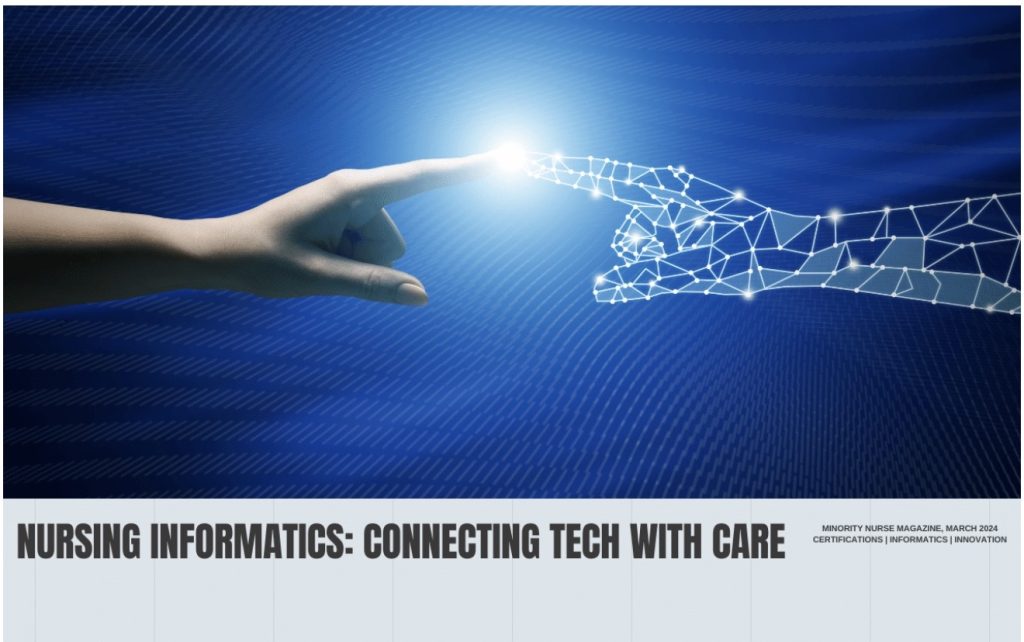
WHAT IS NURSING INFORMATICS?
- Nursing specialty that incorporates the science of nursing with computer science to collect, analyze , manage and communicate health care data, wisdom and knowledge to improve patient care and outcomes (Miller, 2025).
WHY IS NURSING INFORMATICS IMPORTANT?
Per Miller (2025),
- Analyze Patient data and clinical decision support
- Improve patient safety by reducing medication and documentation errors
- Help implement and enhance EMR systems
- Use quality control to measure outcomes that will lead to better patient safety and care.
- Facilitate better communication with staff and patients
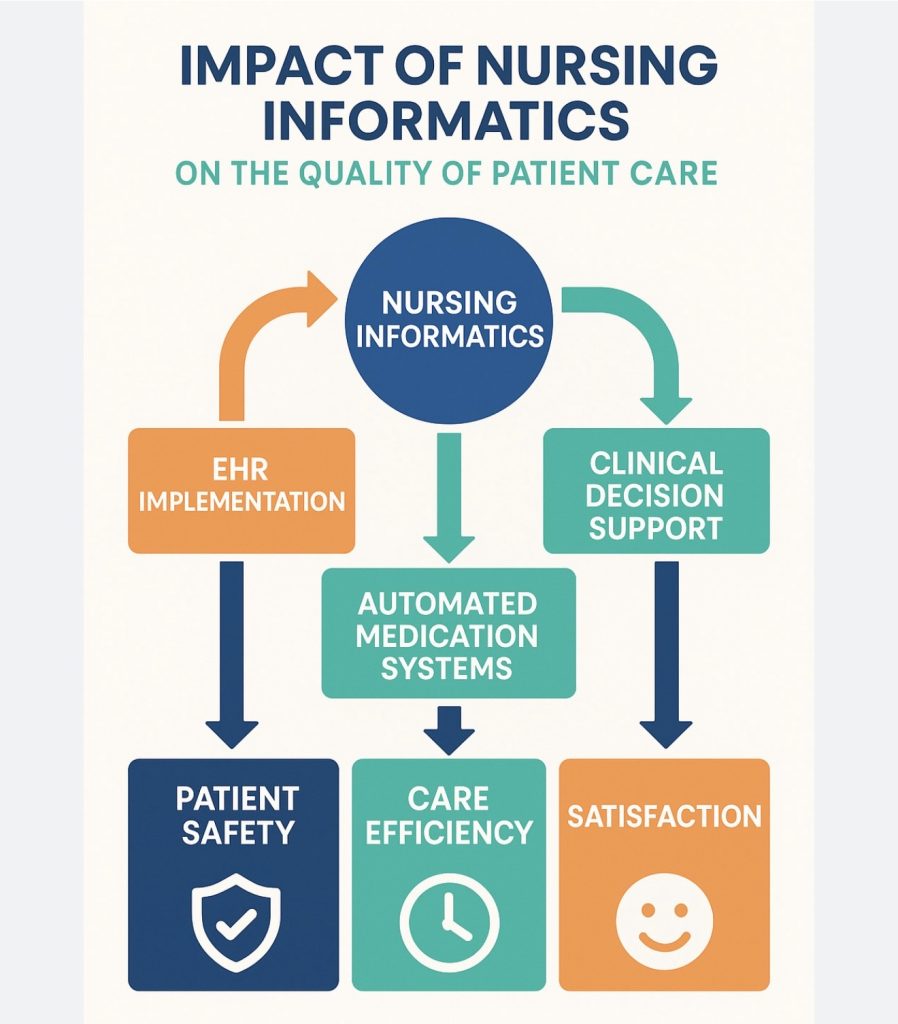
For a more in depth definition please review the following video:
Note. From Nursing Informatics Overview (Nursing Informatics, 2020), YouTube. https://www.youtube.com/watch?v=uv1ScYHH3GE
Clinical Examples of Nursing Informatics
Electronic Health Records and Automatic Data Collection
Electronic health records (EHRs) store and organize patient information so that authorized healthcare professionals can access important information needed for patient care. In clinical settings, data from connected devices such as bedside monitors and glucometers can be automatically transferred into the electronic health record. Automatic data collection can reduce the need for manual entry, make current patient information available to the healthcare team, and support more efficient documentation and patient care (Miller, 2025).
Barcode Medication Administration
Barcode medication administration is an important use of nursing informatics that helps improve medication safety. Nurses scan the patient’s identification band and the medication before administration to confirm the correct patient, medication, dose, route, and time. This technology helps reduce medication errors and creates an electronic record of medication administration. For example, if a nurse scans the wrong medication, the barcode system may alert the nurse before it is administered to the patient(Miller, 2025).
Clinical Decision -Support Alerts
Clinical decision-support alerts are an important part of nursing informatics because they help nurses identify potential safety concerns while providing patient care. These alerts are built into electronic health records and may warn nurses about medication allergies, drug interactions, duplicate therapies, or abnormal laboratory results. By providing important information at the point of care, clinical decision-support alerts can help nurses recognize risks sooner and make safer, more informed clinical decisions.
Note. From Barcode Medication Administration (UK HealthCare, 2014), YouTube. https://www.youtube.com/watch?v=9e9Rtl9_fKc
Telehealth
Telehealth is the use of technology, such as video visits( Mychart, Microsoft Teams), telephone calls and monitoring equipment to provide healthcare to patients remotely. There are different types of Telehealth, including synchronous Telehealth and asynchronous Telehealth. Synchronous Telehealth provides real-time, two-way communication between the patient and the healthcare provider. This allows patients and providers to meet virtually and discuss healthcare needs. Asynchronous Telehealth involves the collecting and sharing health information that does not occur at the same time. An example would be digital images, such as X-rays, which can be captured, stored and sent electronically to healthcare providers for review and diagnosis at a later time. (Miller, 2025)
Telehealth is beneficial for nurses because it allows them to care for patients remotely. It helps nurses follow up on healthcare concerns, monitor patients more efficiently and communicate with patients in both real time and as a later time.
💡Did You Know?
• A Personal Health record (PHR) allow patients to manage and control their health information while sharing it with their healthcare providers.
•During COVID-19, patients with chronic illnesses used Telehealth to stay connected with healthcare providers through remote monitoring.
•An informatics nurse uses technology and healthcare data to improve decision-making, communication and patient care. (Miller, 2025)
Privacy, Security, and Ethical Responsibilities in Nursing Informatics
Nursing informatics involves collecting, accessing, documenting, and sharing sensitive patient information. Therefore, nurses have an ethical and professional responsibility to protect patients’ privacy and maintain the confidentiality and security of health information. The HIPAA Security Rule requires healthcare organizations to use administrative, physical, and technical safeguards to protect electronic protected health information and preserve its confidentiality, integrity, and availability (U.S. Department of Health and Human Services [HHS], 2024).
In clinical practice, nurses can protect electronic patient information by:
- Using individual usernames and strong passwords.
- Never sharing login credentials with another person.
- Logging out of the electronic health record before leaving a workstation.
- Accessing only the records needed to perform assigned duties.
- Verifying recipients before sending patient information electronically.
- Avoiding discussions of patient information in public areas.
- Reporting suspicious emails, unauthorized access, or possible data breaches.
- Following organizational policies when using mobile devices, messaging systems, and telehealth platforms.
Clinical Example
A nurse receives an email that appears to come from the hospital’s information technology department and asks the nurse to enter an EHR username and password through a provided link. Instead of clicking the link, the nurse reports the message to the appropriate department. This action helps prevent phishing, unauthorized access, and possible exposure of patient information. The example demonstrates that nurses are active participants in cybersecurity and not simply users of healthcare technology.
Why Privacy and Security Matter
A breach of electronic health information can damage patient trust, interrupt healthcare services, and expose patients to privacy-related harm. Secure informatics practices allow nurses and other authorized healthcare professionals to exchange information while protecting patients’ rights. Privacy and cybersecurity education should therefore remain part of nurses’ continuing professional development.
Additional Resource:
https://www.hhs.gov/hipaa/for-professionals/security/index.html
Challenges and Future of Nursing Informatics
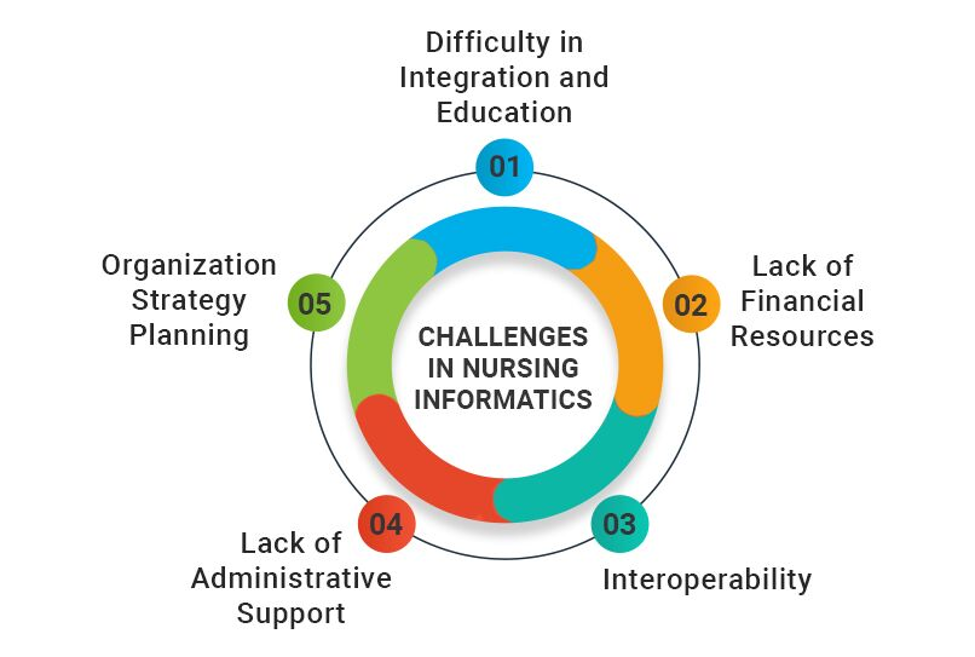
Challenges of Nursing Informatics
- There is a lack of proper training of nurses concerning the use of health information systems because nursing schools do not equip their students well enough for that.
- Nurses require continuous education concerning modern technologies, including EHRs, telehealth, artificial intelligence (AI), and data analytics (Livesay et al., 2024).
- It might be difficult for healthcare organizations to implement new technologies because of the shortage of resources and inadequate infrastructure.
- The gap between what nursing students learn and what knowledge is required to be a competent professional when working digitally makes the situation more complicated.
- The implementation of a unified framework of digital health competencies for nurse educators and practitioners will ease nurses’ job to deliver evidence-based practice (Livesay et al., 2024),
- Why This Matters:.Nursing informatics is the use of information technology with regard to nursing knowledge to enhance healthcare delivery processes. Nursing informatics requires the use of new technologies amid the challenges of cybersecurity, education, and usability of technology.
Future of Nursing Informatics
As such, in the future, the field of nursing informatics will continue to evolve alongside technological evolution. Artificial intelligence (AI) technology will play an increasingly important role in analysis of patient information, disease detection, and decision-making processes. Prediction models may assist in the identification of patients who may suffer from complications before any symptoms are evident (Nashwan et al., 2025). Remote monitoring and wearable health devices will allow nurses to observe vital signs of patients even when they are outside of the healthcare facility, hence making the treatment of chronic illnesses and preventing hospital readmission easier (Nashwan et al., 2025).
The Day and Life of a Informatics Nurse
- Rounding on clinical users with analysts: Identify what what programs are working well. Identify what systems can be improved. Provide education to users and report issues to analysts.
- Attend daily huddle: Be present for morning reports that address safety concerns. Concerns may include EHR reports that show lack of proper utilization.
- Facilitate decision making councils: Review requests and recommendations from staff that make documentation less complicated.
- Support or sponsor optimization workgroup teams: Collaboration with nurses, providers, pharmacists, leaders, and analysts to improve the EHR for various treatments.
- Participate in weekly health information systems (HIS) and clinical operational leadership planning meetings: Gather information on new and current projects. Help to influence and prioritize use of resources. Observing system updates and interfaces.
- Networking and continuing education: Meet with colleagues to share success stories. Collaborate on challenges. Stay informed on new evidence.
Click the link below to explore the daily routine of a Informatics Nurse:
References:
Livesay, K., Walter, R., Petersen, S., Abdolkhani, R., Zhao, L., & Henderson, K. B. (2024). Challenges and needs in digital health practice and nursing education curricula: A gap analysis study. (preprint). Journal of Medical and Internet Research Medical Education, 10, e54105–e54105. https://doi.org/10.2196/54105
Miller, K. S. (2025). Informatics and nursing: Opportunities and challenges (7th ed.). Wolters Kluwer.
Nashwan, A. J., Cabrega, J. A., Othman, M. I., Khedr, M. A., Osman, Y. M., El‐Ashry, A. M., Naif, R., & Mousa, A. A. (2025). The evolving role of nursing informatics in the era of artificial intelligence. International Nursing Review, 72(1), e13084. https://doi.org/10.1111/inr.13084
Nursing Informatics. (2020, November 12). Nursing informatics overview [Video]. YouTube. https://www.youtube.com/watch?v=ub1ScYHH3GE
UK HealthCare. (2014, March 6). Barcode medication administration [Video]. YouTube. https://www.youtube.com/watch?v=9e9Rtl9_fKc
U.S. Department of Health and Human Services. (2024). The Security Rule. https://www.hhs.gov/hipaa/for-professionals/security/index.html
Attachments
| File | Size | Added |
|---|---|---|
| image (7) | 314 KB | Jul 15, 2026 |
| Screenshot | 249 KB | Jul 12, 2026 |
| Screenshot | 217 KB | Jul 12, 2026 |
| Screenshot | 217 KB | Jul 12, 2026 |
| Screenshot | 249 KB | Jul 12, 2026 |
| B01C43E8AC2EE8B7BFD5FEC28279DFF918360F67809E8869DC0F3C7_cpEt | 19 KB | Jul 12, 2026 |
Leave a Reply