Group 2 Members: Jacob, Kayla, Latina, Arealia, Melissa, Noel
Please use this page to add your content, images, videos, links to additional content, and reference section.
Nursing Informatics: A Foundation for Clinical Nursing Practice
What is Nursing Informatics?
Improvements in clinical nursing practice through informatics has changed the face of healthcare worldwide. Nursing informatics is a specialty that combines nursing science, computer science, and information science to collect, manage, analyze, and communicate health information. Its purpose is to improve patient care, support clinical decision-making, enhance communication among healthcare professionals, and promote positive patient outcomes. (McGonigle & Mastrian, 2025).
According to the American Nurses Association (ANA), nursing informatics integrates nursing science with multiple information and analytical sciences to identify, define, manage, and communicate data, information, knowledge, and wisdom in nursing practice (American Nurses Association, 2022).
Nurse informaticists contribute to healthcare in a variety of professional roles, including technology developers, educators, researchers, chief nursing officers, chief information officers, software engineers, implementation specialists, policy advisors, and business leaders. Through these positions, they help improve healthcare delivery by designing, implementing, and optimizing health information technologies.

Why is Nursing Informatics Important?
Nursing Informatics improves healthcare by:
- Enhancing patient safety through barcode medication administration (BCMA)
- Reducing medication and documentation errors
- Improving communication among healthcare providers
- Supporting evidence-based practice
- Providing real-time access to patient information
- Improving quality improvement initiatives
- Increasing efficiency in documentation
- Supporting population health management
- Providing resources for patient education
- Empower and Teach personal health accountability
Applications of Nursing Informatics in Clinical Nursing
Electronic Health Records (EHRs)
Electronic Health Records allow healthcare providers to securely access and update patient information in real time.
Clinical Example:
A nurse caring for a patient with diabetes reviews laboratory results, medication history, allergies, and previous admissions within the EHR before administering insulin.
Barcode Medication Administration (BCMA)
Barcode technology helps verify the “Five Rights” of medication administration:
- Right patient
- Right medication
- Right dose
- Right route
- Right time
Clinical Example:
Before administering antibiotics, the nurse scans the patient’s wristband and medication barcode. The system alerts the nurse if there is a mismatch or allergy, preventing medication errors.
Telehealth
Telehealth allows nurses and providers to monitor and educate patients remotely using secure communication technology.
Clinical Example:
A home health nurse conducts a virtual visit with a patient recovering from heart failure to review weight changes, medication adherence, and symptoms.
Clinical Decision Support Systems (CDSS)
CDSS or Clinical decision support provides alerts, reminders, and evidence-based recommendations.
Clinical Example:
The EHR alerts the nurse that a patient has a severe penicillin allergy before an antibiotic is administered.
Remote Patient Monitoring (RPM)
Remote Patient Monitoring is the use of medical devices connected digitally to the internet that provide real time patient health data remotely
Clinical Example:
A patient with a (CGM) continuous glucose monitoring system can manage their own glucose from home and through their device they can also log and automatically send blood sugar results to their provider in real time.
Telepresence Robot
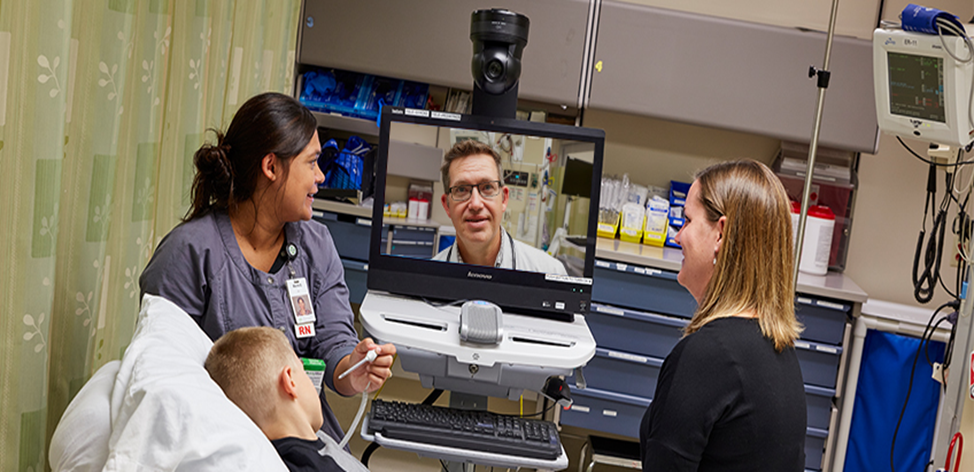
The telepresence robot promotes using improvements in clinical nursing practice through informatics by programming a mobile robotic screen that moves about the facility and projects the provider to allow MDs and NPs to be more present and offer an extended clinical reach.
Clinical Example:
The nurses at a facility are preparing to do rounds however the doctor has just finished rounds at a facility across town. This doctor projects from the telepresence robot that moves through the facility side by side with the nurses as they conduct rounds improving response times to real time issues and bridging the gap of the second hand non verbal communication aspects of patient assessment that may be lost in email or telephone communication.
Video Remote Translator
Video Remote Translation has the capabilities to instantly get face to face language translation right at beside to assist with servicing a diverse clientele.
Clinical Example:
A patient comes in an needs to go through the registration process at the hospital however they speak Ukrainian. The nurse at the desk selects Ukrainian and one of the 24/7 translators is place on video to assist with registering the patient in their own language. This allows for prompt service while providing the comfort of face to face interaction to a diverse population.
Real-World Examples of Nursing Informatics
Example 1: Preventing Medication Errors
A medical-surgical nurse scans a patient’s wristband before administering insulin. The barcode system alerts the nurse when the entered insulin dose is incorrect. The nurse corrects the dose, preventing a potential medication error.
Example 2: Early Detection of Sepsis
An electronic health record identifies abnormal vital signs and laboratory results consistent with possible sepsis. The system alerts the nurse, who immediately initiates the hospital’s sepsis protocol, leading to earlier treatment and improved patient outcomes.
Example 3: Preventing Hospitalization in a Home Health Patient with Congestive Heart Failure using Telehealth
A Home Health Nurse Case Manager received a call from the agency’s telehealth nurse, who reported that the patient’s morning vital signs showed a 4-pound weight gain in one day. The RN Case Manager called the patient, who stated, “My legs are very swollen.” The RN conducted a home visit the same day, contacted the patients physician while in the home, and received an order for an extra dose of Lasix that day.
Example 4: Real Time Patient Data
Smart scales and blood pressure cuffs utilized in the patients home and connected to the internet send messages to providers with information regarding rapid weight gain and changes in blood pressure trends that indicate, fluid retention and stroke or heart attack risks, that can be identified so that necessary medication changes can be made.
Real-World Perspective from a ED Nurse
A great example of how nursing informatics applies to clinical practice comes from Nicole Duke, a board-certified nurse informaticist. In her webinar, Nicole shares her journey transitioning from working as an emergency department nurse to a full-time informatics role. She explains how her bedside ED experience helps her understand real nursing workflows and design technology solutions that actually support nurses rather than create extra work (Duke, 2025).
This perspective shows that nursing informatics is not just about systems — it’s about improving patient safety, reducing errors, and making technology work better for frontline nurses like those in the ED.
References
American Nurses Association. (2022). Nursing informatics: Scope and standards of practice (3rd ed.). American Nurses Association.
Barcode Technology with Laura Willis, RN. (2011, June 10). [Video]. YouTube. https://www.youtube.com/watch?v=9zuE2vpHcEk&t=35s
Duke, N. (2025). Nursing Informatics Webinar Series Part 1: Nursing Informatics 101 [Video]. Dossier. https://www.youtube.com/watch?v=RPjGziNMboo
McGonigle, D., & Mastrian, K. G. (2025). Nursing informatics and the foundation of knowledge (6th ed.). Jones & Bartlett Learnin
Trinity Health Mid-Atlantic (2014, August 7) Testimonial: Mercy Home Health’s Telehealth Program [Video]. YouTube. https://youtube.com/watch?v=w2HZtxvG_5Q
Miller, K. (2025). Informatics and nursing: Opportunities and challenges (7th ed.). Wolters Kluwer.
Attachments
| File | Size | Added |
|---|---|---|
| image | 797 KB | Jul 15, 2026 |
| business medical presentation | 33 KB | Jul 10, 2026 |
| nursing im | 30 KB | Jul 10, 2026 |
Leave a Reply