Group 2 Members: Katherine B, Amy B, Megan B, Ahlam B, Brittnae B, Arianna B, Raven C
Please use this page to add your content, images, videos, links to additional content, and reference section.
Nursing Informatics
Connecting Nursing Knowledge, Patient Data, and Technology to Support Safer Care
Nursing Informatics: is a specialty of healthcare informatics. It’s aim to improve patient care through rapid access to patient data, systematic assessment, a reduction in clinical errors, evidence-based practice, cost-effectiveness, and improved patient outcomes and safety.
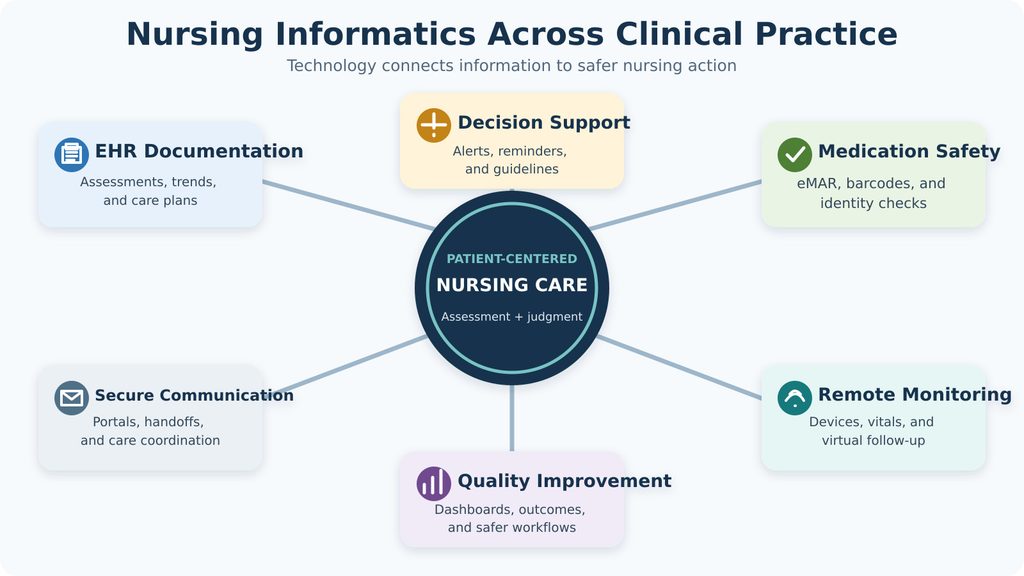
Nursing informatics is more than using a computer or learning an electronic health record (EHR). It is the connection between nursing knowledge, clinical judgment, people, and technology. A nurse uses informatics when documenting an assessment, reviewing lab trends, scanning a medication, responding
to an alert, sending secure education through a patient portal, or reviewing a remote device transmission. Technology organizes and delivers information, but the nurse still has the responsibility to decide whether it is accurate, relevant, and appropriate for the patient.
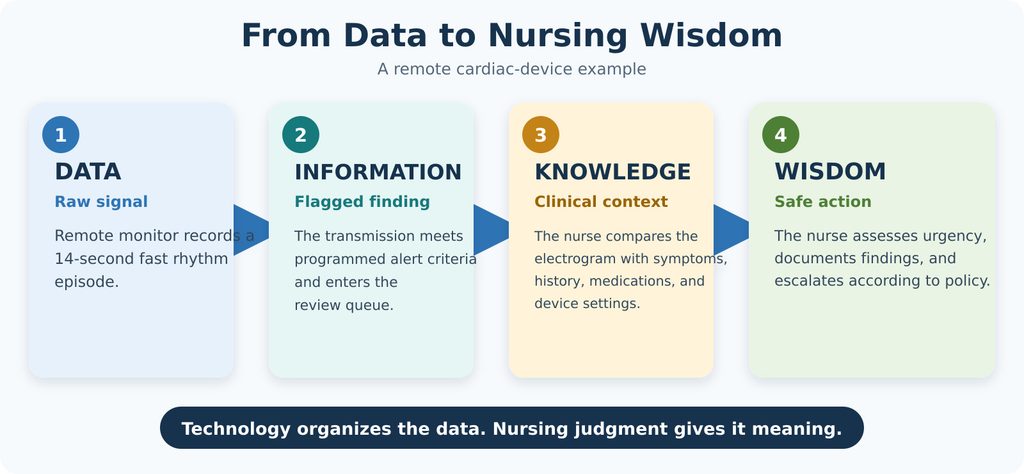
The movement from data to wisdom explains why technology alone is not enough.
Example of data to wisdom in bedside care:
- Data: A patient’s vital signs show a blood pressure reading of 180/100 mmHg.
- Information: Reviewing the EHR trend shows their blood pressure was 120/80 mmHg two hours ago.
- Knowledge: Recognizing that 180/100 mmHg is severe acute hypertension and checking for symptoms like headache or vision changes.
- Wisdom: Holding scheduled medications that could interact poorly, check eMAR for an active PRN antihypertensive order, immediately notifying the provider and closely monitor the patient.
A number or alert has limited value until it is placed in the patient’s clinical context. The nurse combines the digital record with assessment findings, the patient’s report, current evidence, and experience. This process turns a computer-generated signal into a safe clinical action (ANA, 2022).
Why Nursing Informatics Matters
Electronic records can improve access to information, coordination, patient participation, safety, and quality improvement when the systems are designed and used well. Nursing informatics matters because nurses enter, verify, communicate, and act on health data throughout an entire patient
encounter. Accurate documentation supports continuity of care, while incomplete or incorrect data can follow the patient and affect later decisions (Office of the National Coordinator for Health Information Technology [ONC], n.d.-b).
- Patient safety: Identity checks, allergy warnings, medication scanning, and trend alerts can help
prevent avoidable harm. - Communication: A shared record gives nurses and the interprofessional team a consistent view of
the patient’s condition and plan of care. - Efficiency: Well-designed templates, flowsheets, and work queues place useful information where
it is needed and reduce unnecessary steps. - Quality improvement: Dashboards and reports help nurses identify patterns in falls, infections,
readmissions, staffing, and other outcomes. - Patient participation: Portals, secure messages, and electronic education allow patients and
caregivers to review information and participate in decisions.
Did You Know?
Nurses use informatics every day, often without realizing it!
From documenting patient care assessments and reviewing lab results to administering medications and communicating with the healthcare team, technology is a major part of modern nursing practice.
Nursing informatics helps nurses organize patient information, make safe clinical decisions, and provide better care (ANA, 2023).
Common Applications in Clinical Practice
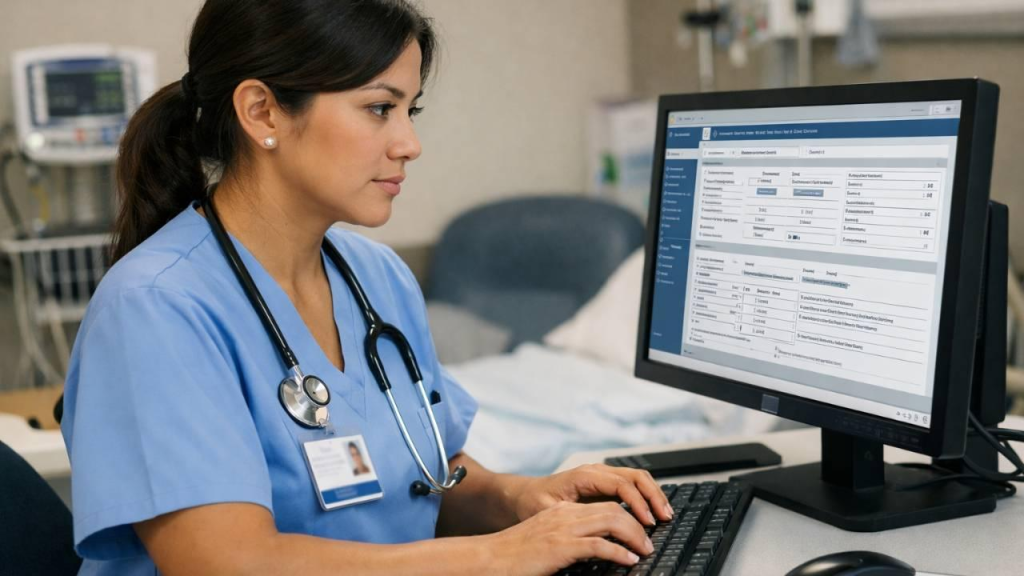
Electronic Health Records and Documentation
The EHR is a real-time, longitudinal record that may include assessments, diagnoses, orders, medication lists, laboratory results, care plans, and education. Nurses contribute a large portion of this clinical information. Clear, timely, and objective charting makes the record useful to the next person providing
care. Nurses must also verify copied-forward information and correct errors according to organizational policy (ONC, n.d.-b).
Clinical Decision Support
Clinical decision support uses patient-specific data to provide reminders, alerts, order sets, summaries, reference materials, or guideline-based recommendations. Examples include an allergy alert, a sepsis screening prompt, or a reminder that a patient is due for fall-risk reassessment. These tools can reduce errors when the information is timely and fits the workflow, but they support rather than replace nursing assessment and judgment (ONC, n.d.-a).
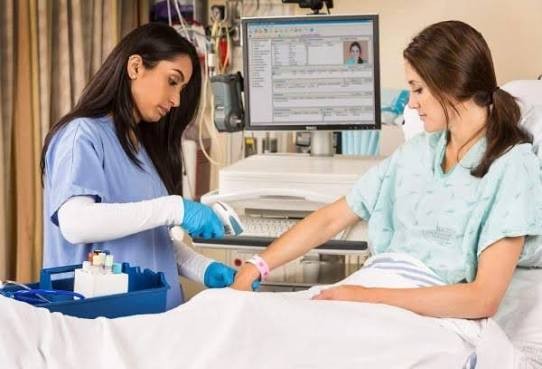
Barcode Medication Administration and the eMAR
Barcode medication administration connects the patient’s identification band, the medication barcode, and the electronic medication administration record. This technology supports the five rights of medication administration: the right patient, medication, dose, route, and time. It remains important to
scan at the bedside, address alerts, and follow the approved downtime process instead of creating workarounds (Agency for Healthcare Research and Quality [AHRQ], n.d.).
This video from Level Up RN (2024) reviews the core rights of safe medication administration and documentation best practices.
Remote Monitoring, Telehealth, and Patient Portals
Remote monitoring can bring home vital signs, glucose readings, rhythm data, or cardiac-device transmissions into the clinical workflow between visits. Telehealth and patient portals also support education, follow-up, and secure communication. These tools only improve care when responsibilities are clear, alerts are reviewed on time, and patients know how to stay connected and when to seek urgent care (Ferrick et al., 2023).
Data Analytics and Quality Improvement
Nursing data can be summarized to identify trends that are difficult to see in one chart. A unit may monitor catheter-associated infections, pressure injuries, falls, medication errors, or discharge delays. Informatics helps the team define the measure, verify the data, test a change, and determine whether outcomes improved. A dashboard is useful only when the data are accurate and the results lead to action (ANA, 2022; ONC, n.d.-b).
Bedside Application: Quality Dashboards in Practice
- Nurse-Sensitive Quality Indicators: Tracking metrics such as hospital- acquired pressure injuries (HAPIs), catheter- associated urinary tract infections (CAUITs), and fall rates.
- Proactive intervention: Spotting a sudden uptick in unit falls allows the nursing team to reevaluate fall-risk scoring tools, bed-alarm monitoring, and hourly rounding compliance before patient harm occurs (ANA, 2022).
Interoperability and Care Coordination
Interoperability means that authorized systems can securely exchange and use health information. When records from hospitals, clinics, pharmacies, laboratories, and remote-monitoring platforms are available across settings, nurses can make decisions from a more complete picture. Gaps in information exchange may cause duplicate work, delayed treatment, or an incomplete medication history (ONC, n.d.-b).
Careers in Nursing Informatics
As a nurse, there are a variety of career opportunities to explore that blend nursing and technology. Some of these jobs include: Nurse Informatics Specialist, Clinical Analyst, Director of Clinical Informatics, Nurse Educator, Chief Nursing Informatics Officer, and EHR Implementation Manager. (Miller, 2025)
IN Specialist
An Informatics Nurse Specialist is a registered nurse who has completed either a master’s degree in informatics or has a certificate in this field. They primarily work with healthcare data. They can implement a new system, teach the staff how to use the new system, provider end-user assistance, and help refine the program to meet their hospital’s needs. (Miller, 2025)
Clinical Analyst
As a Clinical Analyst, the nurse is primarily using data for improvement to improve processes and efficiency for the betterment of the patients and the company. (Miller, 2025)
Director of Clinical Informatics
The job of Director of Clinical Informatics involves the design of the health information technology in order to get the data that is the most useful for that hospital’s needs. (Miller, 2025)
Nurse Educator
A nurse educator is usually an RN with a master’s degree in Nursing Education. Due to the integral role of technology in healthcare, the role of the Informatics Nurse Educator assists in teaching staff in how to use the EHR and other widely-used forms of technology used at their hospital. (Miller, 2025)
Chief Nursing Informatics Officer
As a Chief Nursing Informatics Officer, this nurse in a leadership role as an executive. This position manages all aspects of patient records and informatics. (Miller, 2025) The previous positions all report to the CNIO.
EHR Implementation Manager
Another role in nursing informatics is that of the EHR Implementation Manager. In this position, the informatics nurse will be part of the team that selects an EHR system and oversees implementing the new EHR system for the hospital. This involves end-user training, program implementation and transition, and then customizing the EHR system for the hospital’s specific needs to make it functional to use and to better obtain the needed data. (Miller, 2025)
Challenges
Nursing Informatics provides many benefits. There are also challenges, technology can create technical problems, documentation burdens, workflow interruptions. While excessive alarms may increase alarm fatigue.
- Copy-Forward & Template Risks: Over-reliance on cloned notes or pre-populated documentation templates can obscure subtle changes in patient’s clinical conditon over time.
- Downtime & Outages: Planned system updates or sudden network failures require a rapid transition back to paper charting, demanding strong nurse knowledge of downtime workflows.
For these reasons, nurses should remain engaged and not use tools to replace clinical judgement.
Nurses also have an important role in evaluating if healthcare technology improves patient outcomes. Because they interact with these systems directly, they can identify problems with workflow, documentation, alerts and usability. The ANA notes that informatics nurses may help optimize EHR systems, customize workflows, and identify oppurtunities for process improvement.(American Nurses Association, 2023).
Common Electronic Health Record (EHR) Systems
EHRs allow healthcare professionals to document, access, and share information electronically with the rest of the healthcare team.
Common EHR information includes health history, diagnoses, medications, allergies, laboratory results, vital signs, treatment plans, and clinical documentation.
The four main EHR systems are Epic, Oracle Health, MEDITECH, and Altera Digital Health – Sunrise.
EHR systems may look different depending on the organization but the overall purpose is to provide timely access to patient information and support safe, coordinated care (Office of the National Coordinator for Health Information Technology {ONC}, 2025)

EPIC: Nurses can use Epic to review patient information, document care, follow clinical changes, coordinate care, and support medication administration and other clinical workflows (Epic Systems Corporation, n.d.)
Oracle Health (Cerner): An EHR system that allows healthcare professionals to document, display, store, retrieve, and exchange patient information with each other. The system includes functions such as charting, medication administration, orders, and clinical documentation (Oracle, 2026)

MEDITECH: An EHR system supports clinical workflows and gives professionals access to patient information across the continuum of care. Nursing flowsheets include bedside documentation, medication scanning, clinical decision support, patient alerts, and access to patient data (Medical Information Technology, n.d.)
Altera Digtal Health (Sunrise): is an EHR platform that supports clinical workflows and provides healthcare professionals with patient information at the point of care (Altera Digital Health, n.d.).
Clinical Example: Remote Cardiac Device Monitoring
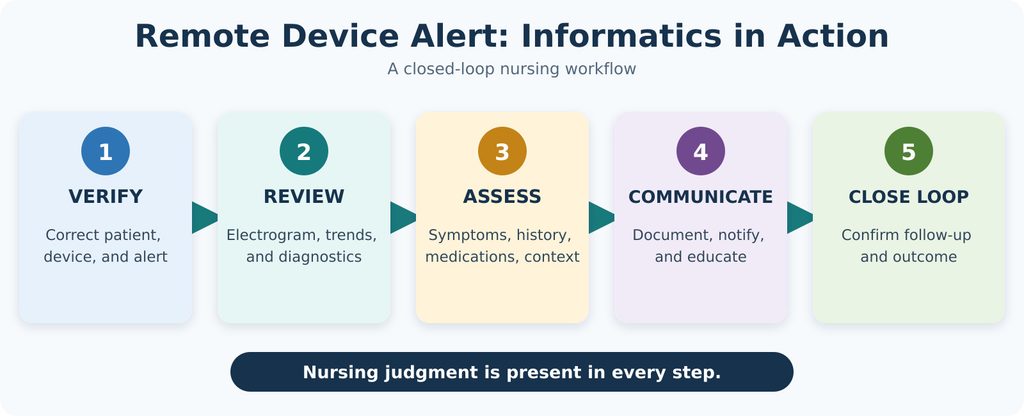
In a device clinic, remote monitoring may identify an arrhythmia, battery change, lead concern, or loss of connectivity. The nurse first confirms the patient and device, then reviews the stored electrogram and available diagnostics. The finding is compared with symptoms, medications, history, and prior transmissions in the EHR. The nurse documents the review, follows established alert pathways, communicates with the provider and patient, and confirms the next step. The 2023 expert consensus on remote device clinics recognizes that safe monitoring depends on appropriate staffing, alert management, patient education, communication, and dependable workflows (Ferrick et al., 2023).
Professional and Ethical Responsibilities
Protecting electronic health information is part of safe nursing practice. The HIPAA Security Rule requires administrative, physical, and technical safeguards that preserve the confidentiality, integrity, and availability of electronic protected health information. Nurses support these protections through their everyday choices at the workstation, bedside, telephone, and patient portal (U.S. Department of Health and Human Services [HHS], 2026).
- Use accurate data: Verify the correct patient, document promptly and objectively, and correct errors through the approved process.
- Protect privacy and security: Access only information needed for the role, protect passwords, lock screens, verify recipients, and use approved communication methods.
- Maintain clinical judgment: Validate alerts, trends, and automated recommendations against the patient assessment and clinical context.
- Avoid unsafe workarounds: Follow scanning, documentation, alert, and downtime policies, and report barriers that make safe work difficult.
- Promote equitable access: Consider language, disability, health literacy, internet access, and digital skills, then offer another method when technology creates a barrier.
- Improve the system: Participate in testing, education, safety reporting, workflow redesign, and evaluation of outcomes.
Challenges Nurses Cannot Ignore
When technology does not match the clinical workflow, documentation can become a burden instead of a support. In direct-care nurses, poor EHR usability has been associated with documentation burden and burnout (Gesner et al., 2022). The answer is not to normalize unsafe workarounds. Nurses should report problems, help redesign the workflow, and evaluate whether a change improves safety, workload, and outcomes. A system can function technically and still fail at the bedside.
The Future of Nursing Informatics
Artificial intelligence, predictive analytics, natural-language processing, wearable devices, and virtual care will continue to change nursing practice. These tools may identify patterns faster, but the output depends on the quality and completeness of the data. Nurses must be able to question an unexpected result, recognize possible bias, and protect the patient’s voice. Informatics competence includes knowledge, skills, and professional attitudes, and it must continue to grow as nursing roles and technology change (Kleib et al., 2021). Nursing also needs an active voice in the design and leadership of digital health so that technology supports both quality care and the human relationship at the center of nursing (Booth et al., 2021).
Interdisciplinary Organizations and Workgroups for Nurses
Healthcare Information and Management Systems Society (HIMSS) Founded in 1961
Not-for-profit organization dedicated to promoting a better understanding of healthcare information and management systems. It also supports free access to the Online Journal of Nursing Informatics.
European Federation for Medical Informatics (EFMI) Founded in 1976
Formed to advance international cooperation and dissemination in medical informatics and to support European nurses and nursing informatics as well as to build informatics contact networks.
International Medical Informatics Association (IMIA) Established in 1967
A nonpolitical, international, scientific organization whose goals include promoting informatics in healthcare, promoting biomedical research, advancing international cooperation, stimulating informatics research and education, and exchanging information.
Many countries belong to the (IMIA), and they meet to focus on issues pertaining to their nations to allow them to establish a national network where ideas can be shared and provide a place to gain information for specific national problems.
American Health Information Management Association (AHIMA) Formed in 1928
Created to improve clinical records and empower people to impact health while offering credentialing programs in health information management, coding, and healthcare privacy and security.
American Medical Informatics Association (AMIA) Formed in 1988
Created to support the development and application of medical informatics to support patient care, education, research, and administration while offering continuing education, annual conferences, a clinical informatics board review course for physicians.
Nursing Informatics Organizations
American Nursing Informatics Association (ANIA) Founded in 1982
Their mission is to advance nursing informatics through education, research, and practice in all roles and settings. The AMIA’s Nursing Informatics Working Group (NIWG) is responsible for promoting the integration of nursing informatics into the broader context of healthcare.
Alliance for Nursing Informatics
Membership includes access to the nursing working groups of the AMIA, HIMSS, and ANIA. These groups have a representative, and they all make up the governing director’s group that guides the strategic goals and activities of the ANI.
British Computer Society Nursing Specialist Group (BCS)
Aims to disseminate information about current nursing informatics applications and to encourage the publication of research and development material in this area.
| KEY TAKEAWAYS Nursing informatics succeeds when the right information reaches the right person at the right time and leads to safer, informed, patient-centered action. The computer supports the process; the nurse provides context, judgment, advocacy, and accountability. Informatics is not simply about learning how to use technology. It combines patient information, nursing knowledge, technology, and clinical judgment to provide safe, effective care (American Nurses Association [ANA], 2023). |
REMEMBER
- Nurses both contribute to and use electronic health information.
- EHRs can improve communication, patient safety, care coordination, and access to important health information.
- Informatics tools support clinical decision-making but do not replace nursing judgment.
- Protecting patient privacy and maintaining accurate documentation are professional nursing responsibilities.
- Nurses have an important role in improving healthcare technology because they use these systems directly in clinical practice.
- As healthcare technology continues to evolve, informatics competency will remain an important part of nursing practice.
EXPLORE MORE:
American Nurses Association (ANA) — Nursing Informatics
Learn more about nursing informatics and how nursing knowledge and technology work together to improve patient care.
https://www.nursingworld.org/content-hub/resources/nursing-resources/nursing-informatics/
HealthIT.gov — Electronic Health Records and Their Benefits
Learn more about EHRs and how electronic health information can support patient safety, clinical decision-making, communication, and coordinated care.
https://healthit.gov/health-it-basics/benefits-ehrs/
Quality and Safety Education for Nurses (QSEN) — Nursing Competencies
Explore informatics as one of the major competencies nurses need to provide safe and high-quality patient care.
https://www.qsen.org/competencies-pre-licensure-ksas
Healthcare Information and Management Systems Society (HIMSS)
Explore additional resources related to nursing informatics, digital health, healthcare technology, and professional development.
https://www.himss.org/
References:
Agency for Healthcare Research and Quality. (n.d.). Bar-coded medication administration. Digital Healthcare
Research. Retrieved September 7, 2026, from https://digital.ahrq.gov/bar-coded-medication-
administration
Altera Digital Health. (n.d.). Sunrise™: The full picture. https://www.alterahealth.com/solution/sunrise/
American Nurses Association. (2023, July 5). What is nursing informatics and why is it so important? American Nurses Association
American Nurses Association. (2022). Nursing informatics: Scope and standards of practice (3rd ed.).
https://www.nursingworld.org/nurses-books/nursing-informatics-scope-and-standards-of-practi/
Booth, R. G., Strudwick, G., McBride, S., O’Connor, S., & Solano Lopez, A. L. (2021). How the nursing profession
should adapt for a digital future. BMJ, 373, n1190. https://doi.org/10.1136/bmj.n1190
Epic Systems Corporation. (n.d.). Acute and inpatient care. https://www.epic.com/software/acute-and-inpatient-care/
Ferrick, A. M., Raj, S. R., Deneke, T., Kojodjojo, P., Lopez-Cabanillas, N., Abe, H., Boveda, S., Chew, D. S., Choi, J.-I.,
Dagres, N., Dalal, A. S., Dechert, B. E., Frazier-Mills, C. G., Gilbert, O., Han, J. K., Hewit, S., Kneeland, C.,
Mirza, S. D., Mittal, S., … Varma, N. (2023). 2023 HRS/EHRA/APHRS/LAHRS expert consensus statement on
practical management of the remote device clinic. Journal of Arrhythmia, 39(3), 250-302.
https://doi.org/10.1002/joa3.12851
Gesner, E., Dykes, P. C., Zhang, L., & Gazarian, P. (2022). Documentation burden in nursing and its role in clinician
burnout syndrome. Applied Clinical Informatics, 13(5), 983-990. https://doi.org/10.1055/s-0042-1757157
Kleib, M., Chauvette, A., Furlong, K., Nagle, L., Slater, L., & McCloskey, R. (2021). Approaches for defining and
assessing nursing informatics competencies: A scoping review. JBI Evidence Synthesis, 19(4), 794-841.
https://doi.org/10.11124/JBIES-20-00100
Level Up RN. (2024, February 27). Safe medication administration: Pharmacology [Video]. YouTube. https://youtu.be/YHBgApOKpaM
Medical Information Technology, Inc. (n.d.). Expanse for nurses. MEDITECH. https://ehr.meditech.com/ehr-solutions/expanse-for-nurses
Miller, K.S. (2025). Informatics and Nursing Opportunities and Challenges, (7th ed.). Wolters Kluwer
Office of the National Coordinator for Health Information Technology. (n.d.-a). Clinical decision support. Retrieved
September 7, 2026, from https://healthit.gov/clinical-quality-and-safety/clinical-decision-support/
Office of the National Coordinator for Health Information Technology. (2025, December 10). Electronic health records and their benefits. HealthIT.gov. https://healthit.gov/health-it-basics/benefits-ehrs/
Office of the National Coordinator for Health Information Technology. (n.d.-b). Electronic health records and their
benefits. Retrieved September 7, 2026, from https://healthit.gov/health-it-basics/benefits-ehrs/
Oracle. (2026, May). Oracle Health EHR user guide (Release 26.04.01). https://docs.oracle.com/en/industries/health/oracle-health-ehr/ehrfg/index.html
Quality and Safety Education for Nurses. (n.d.). QSEN competencies. https://www.qsen.org/competencies-pre-licensure-ksas
Reid, L., Button, D., Breaden, K., & Brommeyer, M. (2026). Nursing informatics and undergraduate nursing curricula: A scoping review. Nursing Reports, 16(2), Article 42. https://doi.org/10.3390/nursrep16020042
U.S. Department of Health and Human Services. (2026, August 7). Summary of the HIPAA Security Rule.
https://www.hhs.gov/hipaa/for-professionals/security/laws-regulations/index.html
Attachments
| File | Size | Added |
|---|---|---|
| Figure_3_Remote_Device_Alert_Workflow | 166 KB | Sep 13, 2026 |
| image | 76 KB | Sep 12, 2026 |
| image | 115 KB | Sep 12, 2026 |
| image | 262 KB | Sep 12, 2026 |
| image | 99 KB | Sep 12, 2026 |
| image | 152 KB | Sep 12, 2026 |
| image | 81 KB | Sep 12, 2026 |
| image | 150 KB | Sep 12, 2026 |
| image | 99 KB | Sep 12, 2026 |
| image | 99 KB | Sep 12, 2026 |
| image | 905 KB | Sep 12, 2026 |
| emar | 43 KB | Sep 12, 2026 |
| emar | 43 KB | Sep 12, 2026 |
| Figure_2_Nursing_Informatics_Clinical_Practice | 220 KB | Sep 9, 2026 |
| Figure_1_Data_to_Nursing_Wisdom | 209 KB | Sep 9, 2026 |
| IMG_0038 | 42 KB | Sep 7, 2026 |


Leave a Reply
You must be logged in to post a comment.